



Woodworking comes back to two essentials: bonding and repair.
Wood glue supports everything from edgebanding and assembly to laminating and panel work. Wood filler deals with knots, voids, deep scratches and defects that become obvious once finishing begins. This guide is written for joinery, furniture, fit-out, maintenance and manufacturing teams who need reliable outcomes and repeatable processes.
Glue Guns Direct has been supplying adhesives since 1979, and we’re challenged daily to solve real-world bonding and repair problems across different materials and production methods.
Which wood filler should I use?
“Wood filler” is a broad label. The right choice depends on the defect, the finishing requirement, and the pace of the job.
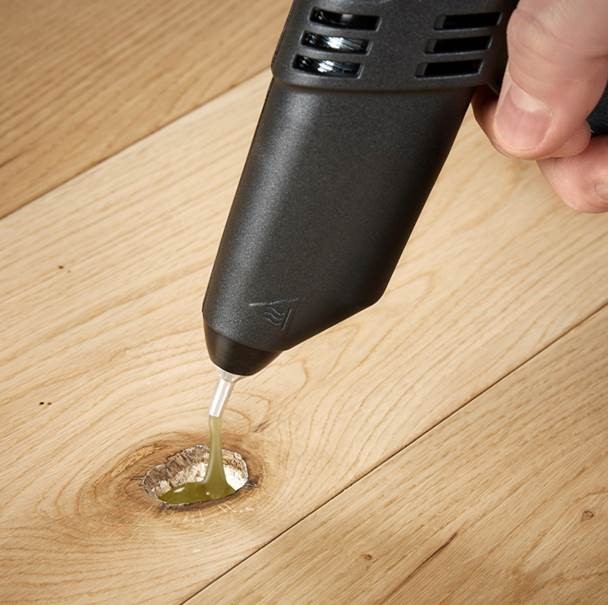
Start with the defect
- Knots and knot pockets
- Cracks, voids and open defects
- Deep scratches, dents and edge damage
- Finishing defects that will show under lacquer, varnish or paint
Match the filler to the finish
Clear coats and stains can make repairs stand out. A good filler choice levels cleanly, stays stable under finishing, and supports colour matching in a way that suits the job.
Consider workflow speed
In production and high-volume repair, waiting for slow cures can become the bottleneck. That’s one reason dedicated repair systems are widely used for timber defects, particularly when the repair needs to be finish-ready and repeatable.
Wood filler for knots and defects
Knots and timber defects are rarely cosmetic. They can be irregular, deep, and prone to becoming visible when the finish goes on. If the work involves repeated defect repair on doors, frames, furniture, flooring or fit-out timber, a dedicated knot-filling route is often the most consistent approach.
Knottec is one example of an industrial wood repair system used for knot filling and defect repair, covering voids, deep scratches and timber imperfections where speed and consistency matter.
Typical uses include:
- Knot pockets and resinous defects that need stabilising before finishing
- Voids and cavities in machined components
- Deep scratches and impact defects
- Touch-ups during installation or maintenance
Which wood glue should I use?
Wood glue isn’t a single product category. The correct choice depends on substrate, joint design, temperature, moisture exposure and the way the glue is applied.
A practical way to narrow it down is to think in terms of application:
Assembly and general joinery
If you need reliable bonds in day-to-day assembly work, the glue must suit the materials, the joint fit, and the working time you need. Process discipline matters as much as product choice: surface prep, coverage and clamp/hold time are where most failures start.
Hot melt application (gun or line)
Hot melt adhesives are widely used when you need fast handling strength, clean application and consistent results. They’re common in manufacturing environments because they support repeatable output and controlled application.
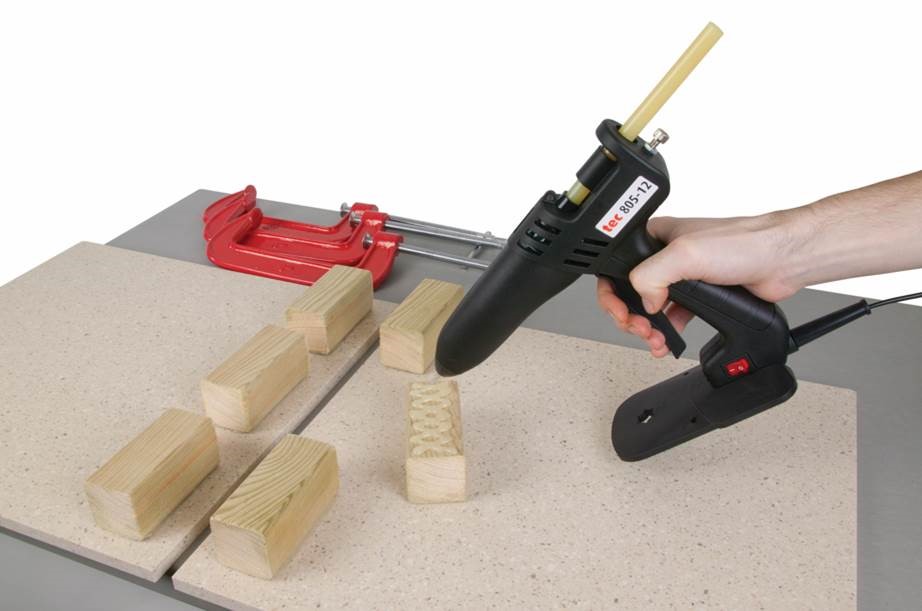
Edgebanding
Edgebanding has its own requirements. You need consistent flow, stable adhesion and a clean glue line that supports the finish quality your customers expect. Glue systems used for edgebanding are typically selected around line speed, open time, board type and edging material. Henkel Technomelt systems are commonly referenced for edge banding, edge lipping and related woodworking processes.
Wood glue types for 2026
Choosing between wood glue types is less about labels and more about performance under heat, moisture and production conditions.
Choosing between wood glue sticks is less about the label and more about how the bond needs to behave on the wood: open time (how long you’ve got to assemble), strength, heat resistance, and adjustability. In the Glue Guns Direct woodworking range, that choice is mainly about picking the right Tecbond formulation for your woodworking workflow.
Tecbond 135 (general woodworking assembly, longer open time)
A go-to woodworking hot melt when you need a bit more working time for assembly, mitre joints, trims and edgings. It’s a long open time product with good adhesion to soft and hard woods, making it well-suited to general joinery-style work where you still want speed but not a frantic set.
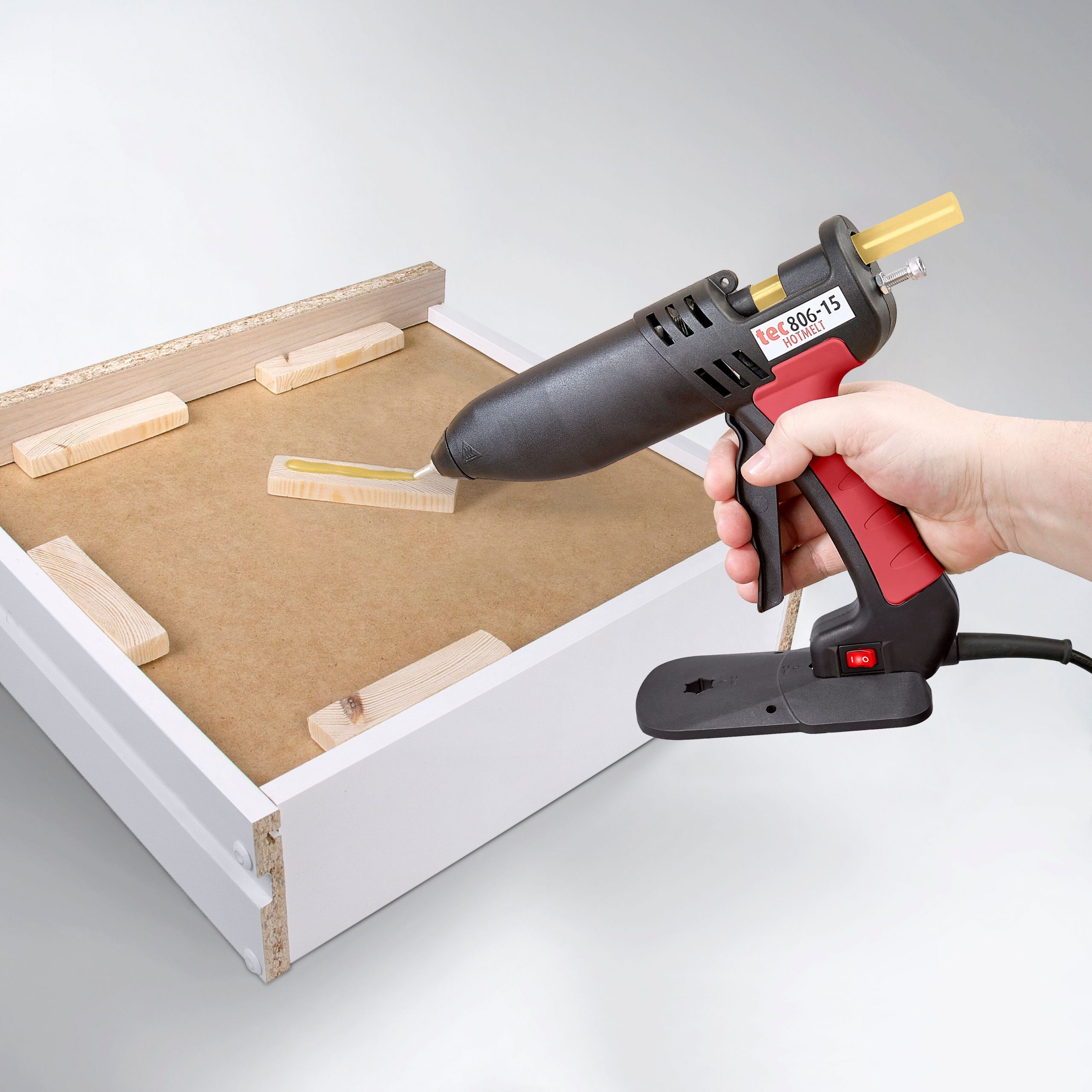
Tecbond 213 (wood bonding, long open time, economical)
A general-purpose long open time hot melt that’s described as suitable for use on wood. It’s the kind of stick you’d choose for routine wood bonding where cost control matters, and you want a forgiving assembly window.
Tecbond 23 (wood assemblies needing very high strength + temperature resistance)
When the wood bond needs to cope with more stress and temperature variation, Tecbond 23 is a very high-strength product with high/low temperature resistance for product assembly. In woodworking terms: the option you reach for when “standard” isn’t enough.
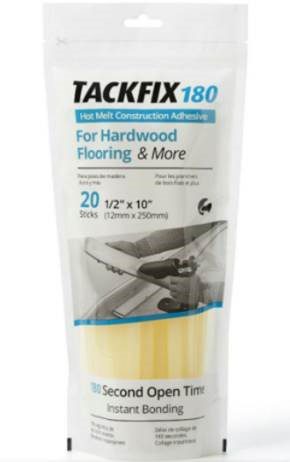
Tackfix 180 (wood/flooring, adjustable bond time)
Useful for wood and flooring tasks where fit-up can be awkward, and you need time to position. It allows bonds to be adjusted for up to three minutes, which is valuable on larger timber pieces, trims, or flooring-related wood components.
Whatever the wood glue stick you choose, bond quality still comes down to basics: clean, dry timber, correct coverage, and controlled application temperature.
How to apply wood filler (repairs that finish cleanly)
A strong repair starts before the filler is opened.
- Prep the defect: remove loose fibres, dust and contamination
- Control the fill: keep the repair neat, especially if staining
- Level correctly: scrape, plane or sand to a flat surface
- Finish test: use offcuts to confirm colour and finish behaviour before committing
Raking light is a useful check. If you can see the repair line before finishing, you’ll usually see it more after finishing.
How to apply wood glue (bonds that don’t fail)
Most glue issues come down to surface prep and process.
- Prepare surfaces: clean, dry, consistent fit
- Apply correctly: full coverage without starving the joint
- Clamp or hold as required: match pressure and time to the application
- Control the process: for hot melt and edgebanding, temperature and throughput affect results
If you’re uncertain about the glue choice for a specific substrate or process, a selection tool can reduce trial and error quickly.
Colour-matched wood filler repairs
Colour matching is the difference between a repair that disappears and a repair that gets noticed.
Practical rules that hold up:
- Match to the finished colour, not raw timber
- Check under the lighting where the product will live
- Remember, clear coats can deepen tone and shift the match
If appearance is critical, test your repair and finish system together on offcuts. It saves time and rework later.
FAQs
What is the best wood filler for knots?
For knot pockets and timber defects that need a consistent, finish-ready repair, a dedicated knot-filling route is usually more reliable than general-purpose filler. Knottec is a system used for knot and defect repair in professional woodworking.
Can wood filler be sanded, stained, or varnished?
Most fillers can be sanded once set. Stain and varnish behaviour varies, so test on offcuts with your exact finish system. If the work will be clear-coated, prioritise a repair approach that stays stable and levels cleanly under finishing.
Wood filler for deep holes and voids: what works best?
For deeper voids, focus on controlled filling and a stable repair that can be levelled without shrink-back. In production settings, faster repair systems are often preferred to keep output moving.
What is the difference between wood filler and wood putty?
The terms are often used interchangeably. The useful distinction is performance: small cosmetic fixes versus defect repairs that must remain stable, level and credible under finish.
Can I use a hot melt system as a wood filler?
Yes. Hot melt repair systems are used for timber defect repairs where speed and repeatability matter, including knot filling and deep scratch repair.
How do I colour-match wood filler repairs?
Work backwards from the final finish. Test under real lighting, and aim for a repair colour that remains close once the topcoat is applied.